
Travel – Well Welcome to MORE 2026
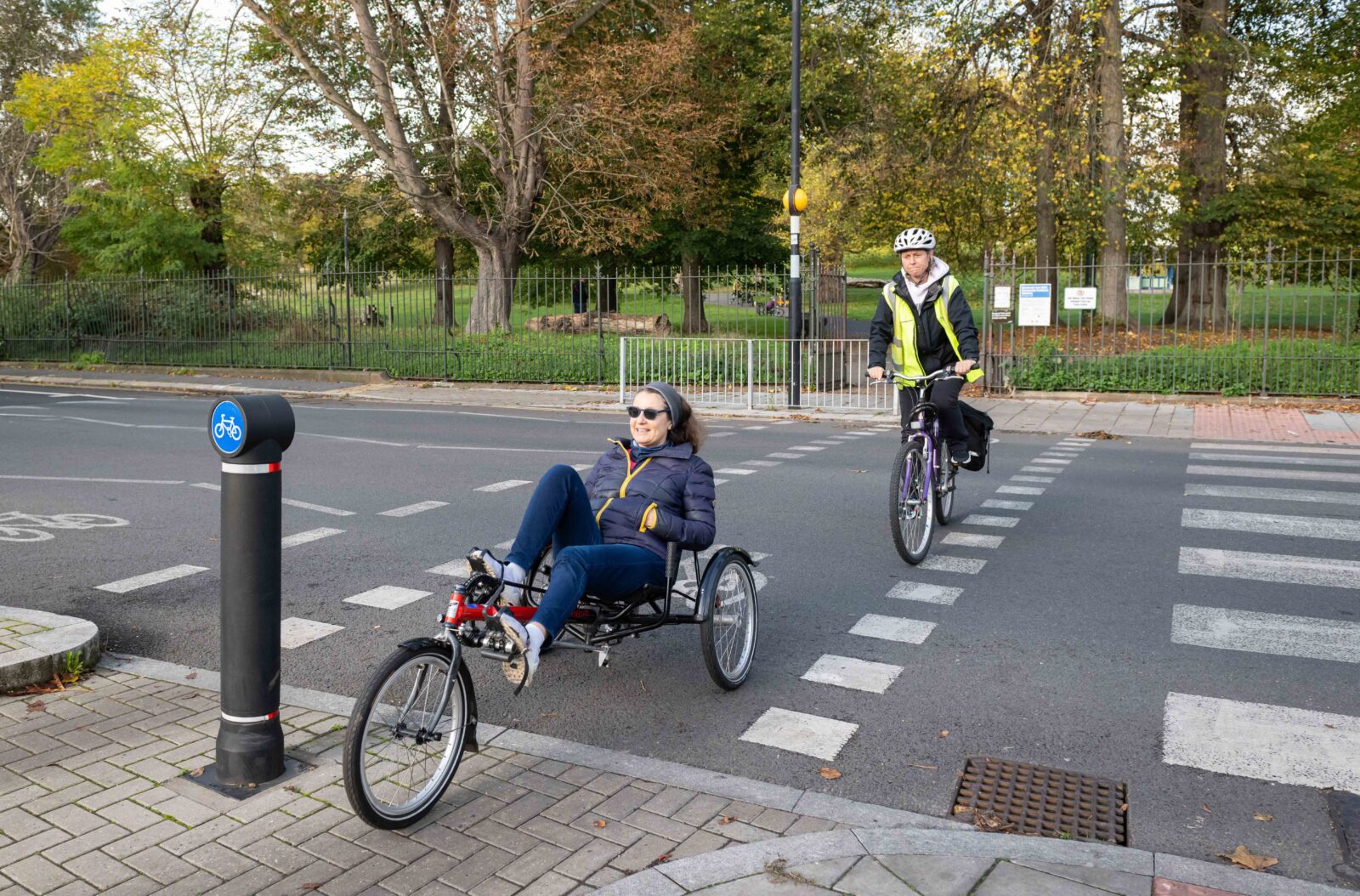
A recumbent cyclist crosses a parallel crossing whilst cycling on a separated cycle track running alongside a main road [© Wheels for Wellbeing]
Lead Researchers: Rachel Aldred & Ersilia Verlinghieri
Other Researchers: Patrice Ajai-Ajagbe, Ellie Cronin, David Fevyer, Jamie Furlong, Harrie Larrington-Spencer, Louise Rondel, Faye Shortland
Partners: Wheels for Wellbeing, University of Birmingham, London School of Hygiene & Tropical Medicine (LSHTM)
Funding: The five-year study is funded by a grant from the national institute for health and social care public health research programme (nihr167654)
This five-year research project investigates the impact of new, high-quality cycling infrastructure in Greater Manchester, West Midlands and West Yorkshire. These regions are planning major investments to their cycling routes and infrasructure aligned with updated national design standards.
The study will assess whether the implementation of this infrastructure shifts travel behaviour, improves health and wellbeing, and reduces car use, carbon emissions and injury risks. Key research questions include: How does new cycling infrastructure affect active travel, car ownership/driving, road traffic injuries, and CO2 emissions? How do these effects vary by area and social group? And What are the impacts on wellbeing and on people from groups that cycle less, and specifically disabled residents?
The mixed method assessment includes in-depth qualitative research to explore personal experiences of infrastructure, focusing particularly on disabled people and ethnic minority communities; and an annual panel survey (nearly 10,000 participants at baseline) to track behavioural and wellbeing changes over time. We have recently interviewed cyclists in Greater Manchester about their experiences of new local cycle infrastructure, and ridden with disabled cyclists to explore how it works for them.
Led by the University of Westminster’s Active Travel Academy, the project also involves health researchers at the University of Birmingham and LSHTM. Regular engagement with local authorities and community groups will help ensure that findings are used to shape better, fairer transport and health policies in England and beyond.
KEY WORDS: active travel; disability; environment