Blog

PLAYHOUSE Competition_Deadline, April 24, 2020, 6pm

Hacking the home to make play part of everyday

Play is an essential part of all our lives, whether child or adult. Be it playing sports, a board game or simply sharing jokes with friends, play is just as important to adults as building a den or playing dress-up is to a child.

The Coronavirus outbreak has left many of us having to spend extended periods of time at home in lockdown, restricting the opportunity to socialise and play in ways that we are used to.

How can we use creativity to encourage play in these unique times?

To download full brief and submit your entry please go to: https://www.playhouse-competition.com/

First wave of submissions by 6pm Friday 24th April 2020 to be featured in May, and second wave by 6pm Friday 22nd May 2020 to be featured in June.

The Society of Architectural Historians of Great Britain: Prizes and Awards in Architectural History_Various Deadlines

In spite of the difficulties the pandemic presents, the Society is pleased to launch its annual Awards programme; our prizes and awards rank among the most prestigious in architectural history internationally. We now have a programme of four awards, each targeted at different sections of the discipline. You do not need to be a member to participate.

For our Book Prizes, nomination is now open until 1 May 2020. Anyone can nominate any eligible title, and authors and publishers are welcome to self-nominate. Nominated titles will then be invited to formally submit for assessment by our judging panels. 

For our Essay Prizes, submission by individuals is open until 1 September 2020. Prize winners will be announced at our Annual Lecture and Awards Ceremony in London (date, TBC). 

The society welcomes submissions of work relating to the history of the built environment from all cognate disciplines and subdisciplines, including but by no means limited to Architecture, Art History, History and Geography.

We encourage work on as diverse a range of themes as possible, including histories of design; histories of planning; histories of construction; histories of buildings in use; histories of interiors and interior design; and histories of practice and professionalism.

We are looking for work in the history of the built environment that is innovative, ambitious and rigorous. Please consider submitting your own work and encouraging students, colleagues and friends to do so too. For more information see below and the Awards page of our website.

The Society of Architectural Historians of Great Britain

To find out more about each award, please click on links below:

James Phillips Travel Prize 2020 _ Deadline: May 4, 2020

Background

The James Phillips Foundation is a charity established in 2015 in memory of James Phillips who died, aged 27, on Sunday 27 September 2014.

James was a partner at Make Architects, and studied architecture at the University of Kingston. The day after he died would have been his first day on Westminster’s Part 3 course. His brother Daniel completed his Part 1 BA Architecture here, and is now studying on the MArch.

James cared about architecture, photography and travel, and for his MA ‘Common Ground: An analysis of public space on an International basis’ he travelled to 24 countries to document – and photograph – their most significant public spaces.

The Prize

In 2016 The James Phillips Foundation very generously set up a travel prize of £1000 per annum for a Westminster architecture student in memory of James.

The only conditions are that the prize money must be used to facilitate travel, and that the goal of that travel should be photographed and archived on The James Phillips Foundation web-site within 6 months of the award being made[1].

Applications & Judging

The prize is open to all students enrolled on an Architecture course at the School of Architecture + Cities at the time of application, although the travel can be undertaken after graduating. Students should make a proposal of maximum 300 words + images demonstrating:

  • How the travel will enable investigation of: either a subject beyond the normal academic requirements of their course, or a specific study for their course that would otherwise be unaffordable (e.g. dissertation, extended essay, studio project).  
  • Why they have chosen a particular destination, or destinations, and what aspect of ‘common ground’ they plan to investigate – and how.
  • A draft travel schedule (in addition to the 300 words)
  • How they use photography to enhance their work

Proposals will be judged against the following criteria:

  • To what extent the proposed travel research will document and enhance knowledge of some aspect of common ground or public space.
  • Feasibility of the proposed travel
  • Quality of the proposal

Timetable

  • Notification of Prize: Monday 7 April
  • Proposal deadline: Monday 4 May submit to School Administrator: Saroja Boolkah S.Boolkah@westminster.ac.uk
  • Announcement of Winner: Friday 19 June (OPEN Awards Evening)

[1] In the current exceptional conditions, this time limit has been extended to 12-months

Congratulations to George Hintzen, DS10 alumnus, on receiving funding through Dragon’s Den for further development of his company TOAD.ai

This episode of Dragon’s Den can be viewed on the BBC iPlayer, and will be available for the next 28 days.

TOAD.ai is a “data-driven outdoor advertising agency powered by technology.”

It was founded by George Hintzen in 2017, and their focus is on consolidating all of the UK’s outdoor advertising locations and layering it with geo-spatial audience data.

Award-winning Architect George held computational roles at top UK offices Heatherwick Studio, Zaha Hadid and Wilkinson Eyre on groundbreaking projects in like the Bombay Sapphire Distillery and Battersea Power Station. He specialised in optimisation of complex geometries and integrated signage – communicative architecture. Drawing from his experiences, he moved into the world of Outdoor Advertising – where the built environment meets media. He loves retrofit infrastructure: Mobile phone masts, billboards and treehouses.

TOAD.ai

Featured image: TOAD.ai

RIBA Part 1 and Part 2 Bursaries _ Deadline: May 15, 2020, 5pm

The aim of the RIBA Part 1 and Part 2 Bursaries is to provide long-term financial support to architecture students who demonstrate talent and commitment to their studies who might struggle to cover the costs of living and course-related expenditure. The schemes have been made possible by generous donations to the RIBA from the Walter Parker Trust, the Rosenberg Memorial Fund and the Ayyub Malik Trust; as well as monies raised through the RIBA Education Fund.

RIBA website

Applications for the 2020 RIBA Part 1 and Part 2 Bursaries are now open. 

RIBA Part 1 Bursary

To be eligible to apply for a RIBA Part 1 Bursary, students must currently be enrolled in the first year of a RIBA Part 1 course in the UK. Recipients of these bursaries will receive a maximum of £6,000 distributed in £1,000 termly instalments throughout the second and third years of study.

RIBA Part 2 Bursary

To be eligible to apply for a RIBA Part 2 Bursary, applicants must be in the process of applying for a RIBA Part 2 course in the UK beginning in September 2020. Applicants do not need to have their place confirmed at the time of application, but if successful, proof of enrolment will be required before the bursary payment is made.  Recipients of these bursaries will receive a maximum of £6,000 distributed in £1,000 termly instalments throughout the two-year course.

The application deadline for both bursary schemes is 5pm Friday 15 May 2020.

For the full details on the application process and to download the application form and guidance notes, please visit the website here

Drawing Matter Writing Prize_ Deadline: June 19, 2020, 5pm

Two cash prizes of £1000 and up to ten awards of £300 for runners-up.

Deadline for entries: 17.00 (GMT) 19 June 2020.

The Drawing Matter Trust is delighted to announce the Drawing Matter Writing Prize. The competition invites a coming generation of writers to consider what drawings reveal about the process of design, and the buildings or objects they represent. We hope to make this an annual event.

Entries to the competition may approach drawing as shorthand for describing any process of design. In this context the word ‘drawing’ is as much a verb as a noun, implying that a purpose exists – perhaps a building or an object – for which it is being made. Certainly, the ‘drawing’ itself may be something other than paper and pencil, a plan or section; it may encompass a sequence or series (such as a sketchbook), and a broad range of techniques, such as collage, photography, models, paintings and, of course, digital media.

Designers or artists are welcome to submit an essay on a drawing of their own. If you are writing about your own work, we are interested in hearing about a specific approach to drawing that you have incorporated into your own practice.

Above all else, we want everybody to write about what they are seeing, and to consider the act of looking itself.

Competition and Awards

The competition is open to anyone between the ages of 18­–40, with or without a background in architecture or design. We welcome a broad range of approaches towards writing, and voices from art history, the sciences and humanities, alongside practitioners – architects, designers, photographers, artists, students and writers.

Entrants to the Writing Prize should submit two texts:

  • A long-form text (1,000–1,500 words)
  • A short-form text (no more than 350 words)

Each text must address a different architectural or design drawing, or sequence of drawings; one of these texts must be on a work from the collection of Drawing Matter. For the long-form text, entrants may choose to include up to 3 additional illustrations.

Two prizes of £1000 each will be awarded, for the best single long- and short-form texts.

In addition, a minimum of five runners-up will each receive £300 – this may be for an entry in either category.

The winners, and other writers with outstanding entries, will be invited to publish their texts on our website. We also plan to incorporate many of the winning texts as an early volume in a series of printed publications, based on material published on drawingmatter.org.

Access to the Drawing Matter Collection

In addition to the drawings published on our public website, drawingmatter.org, entrants can find more material from the Drawing Matter collection through our closed-access catalogue. To look at the collection, register for catalogue access here, stating ‘Writing Prize’ in the ‘company name’ field of the form. If you require a high-resolution photograph of a drawing in the collection, please request one from image.requests@drawingmatter.org. (Entrants should note that our public website, drawingmatter.org, publishes drawings not only from within the collection but also from other sources, which are clearly captioned as such. Drawing Matter material can be verified on the collection website).

Judges

The Writing Prize will be judged by a panel of distinguished writers, scholars and practitioners, with a broad range of interests and experience. The judges will blind-read the texts; their decision will be final and no correspondence will be entered into regarding the judging process.

All winners will be notified by email before the end of August 2020.

See the list of judges here.

More about Drawing Matter

Drawingmatter.org is a growing collection of texts that explore the role of drawing in architectural thought and practice. The majority of the drawings on the website are held in the physical archive of Drawing Matter, based in Somerset, UK. The website also publishes work from other collections, and by practitioners for whom drawing is part of their design process. New writing is published online every week with a selection of articles included in a monthly digital newsletter. Alongside digital projects, Drawing Matter has a robust print publishing programme.

How to enter

(1)

Purchase an entry ticket → Entry Ticket

You will receive an order number with your purchase (can’t find it? See advice here). Please make a note of this as it will be needed for your entry form and will allow us to circulate entries anonymously to the prize judges.

All proceeds from the entry tickets will be applied directly to student scholarships for our annual Architectural Drawing Summer School.

(2)

Download and complete the Writing Prize entry form → Drawing Matter Writing Prize 2020 Entry Form

(3)

Email your completed entry form, long-form and short-form text, and images to editors@drawingmatter.org. Texts and images should be formatted as follows:

Texts:

  • Both texts should be submitted as separate files. Each file name should include your order number and the type of text (short or long): for example, OrderNumberHere_Long-text.doc and OrderNumberHere_Short-text.doc.
  • Texts should be formatted as word documents, double-spaced, 12pt.
  • Numbered image captions should follow the body of each text.
  • Footnotes and bibliographies are not required.
  • Texts should be submitted in English.

Images:

  • Each file name should include your order number and the type of text (short or long) followed by the image number: for example, OrderNumberHere_Long-text_image1.jpeg.
  • Images should have a resolution of 300 dpi and should be .jpeg files.
  • You do not need to submit image files for drawings in the Drawing Matter collection, but they should be included in captions.

Featured image: Rem Koolhaas (*1944), Elia Zenghelis (*1937) and Zoe Zenghelis (*1937), Collage for Exodus, or The Voluntary Prisoners of Architecture, 1972. Pen, ink, photo-collage in colour and black-and-white, on silver backing, 295 × 420 mm from drawingmatter.org.

Call for entries: RIBAJ Eye Line 2020 Competition_Deadline: Monday, June 8, 23:59

KEY DATES

Deadline: Monday 8 June 2020, 23:59.

Judging: end June.

Winners and commendations announced: August issue of RIBAJ and online.

Exhibition opens: August/September.

Correspondence: eyeline.ribaj@riba.org

It’s back!  The 2020 edition of Eye Line, our international free-to-enter competition for drawing and rendering skills, is now open for entries. As ever we ask for images in two categories – student and practitioner – that brilliantly communicate architecture, in any medium or combination of media. It’s the pure art of architecture we’re interested in: ‘New Imagined Worlds’ is the subtitle this year.

We are especially pleased this eighth year of Eye Line to be partnering with Delta Light, the international architectural lighting company. Themselves committed to the art of architectural illustration, they are kindly hosting our judging event.

We are looking for images of all kinds, from hand-drawn concept sketch to technically proficient layered render.  For us, ‘drawing’ includes any method by which the power of an architectural idea is communicated. This includes depictions of existing buildings as well as works of the imagination.

Practitioners and students enter in different categories:

•    Student category – images made by those in architectural education or who are submitting images made before final qualification.

•    Practitioner category:  images made by those fully qualified and working in practice, whether for real-life projects or to explore ideas and experiences.

We will exhibit winners and commendations at the RIBA following a winners’ party there, and will publish them in print and online. And our colleagues at the RIBA’s Drawings and Archives Collection, based in the Victoria and Albert Museum, will inspect our winners for potential inclusion in the collections.

Last year’s practitioner winner was Ed Crooks for his series of pen-and ink fantasias on Lutyens’ Castle Drogo commissioned by the National Trust: student winner was Theo Jones from the Bartlett with his series ‘Unfolding Julian Assange’s Home of Diplomatic Containment’ made in Photoshop and Illustrator. Commendations in all media ranged from sparse elegant line drawings via watercolour on cardboard.

Every year we are gratified by the originality, wit and talent represented in Eye Line: a truly international, free-to-enter award conducted online.  Practitioners and students – show us your best drawings!

Hugh Pearman, The RIBA Journal

For more details and how to apply please go to: https://www.ribaj.com/culture/enter-eye-line

Featured image: RIBAJ

Architecture History + Theory Guest Lecture by Kate Mackintosh “Where wealth accumulates and men decay” available for viewing online

The first lecture in the Architecture History + Theory Guest Lecture series, delivered by Kate Mackintosh on the subject of social housing on February 13, 2020 in the School of Architecture + Cities, is now available for viewing online:

Of the three requirements for realising a civilised life, namely a home, education and health-care, the most fundamental of these is decent and secure shelter, without which the other two are almost impossible to achieve. The link between good housing and health was the stimulus behind the 1919 Addison housing act. With the NHS lurching from crisis to crisis our politicians should brush up on their history.

Featured image: “Dawsons Heights looking NE across the central space.”

“Where wealth accumulates and men decay”, Oliver Goldsmith.

ADAM Architecture Travel Scholarship 2020_Deadline: April 30, 2020

ADAM Architecture is inviting students to apply for the annual Travel Scholarship to support overseas research in architecture, architectural technology and urban design.

The closing date is 30th April 2020. The award of £2,000 supports overseas research in architecture, architectural technology and urban design.

Judges will be looking for a significant piece of original research work, and an outstanding contribution to architectural knowledge. The award is not focused on traditional architecture and the judges are stylistically neutral in their evaluation of the proposals.

The travel scholarship is open to students enrolled at a UK or International University or School of Architecture, studying RIBA Part I; applicants who are 3 years post their Part II qualification; to students studying a CIAT accredited degree, post-graduate course, or equivalent qualification.

First launched in 2005, the scholarship is now in its 15th year and has a proven track record of supporting students to travel overseas to further develop their current research interest or to kick-start something new, often outside of their studies.  A brief summary of the previous winners is on ADAM Architecture website.  Many past recipients have been invited to present their research at a public event hosted by ADAM Architecture.

Talking about his experience, previous Travel Scholarship winner, Sam Little who studied at the Architectural Association, said: 

The Scholarship was fantastic in giving me the impetus to fulfil a project which otherwise would have been left in the locker. It gave me the will and economic means to pursue a trip to Iran to look at 11th century Seljuq buildings. It was a trip which simply would not have been possible without the agency which the scholarship gave me. The whole process was thoroughly enriching and being encouraged to work with freedom helped to place an emphasis on the experience of the trip, rather than any rigid preconceived understanding of the subject.  I would encourage anyone thinking about applying to do so.

Full details and how to apply are available at: www.adamarchitecture.com/academic/travel-scholarship

Friday Technical Surgeries

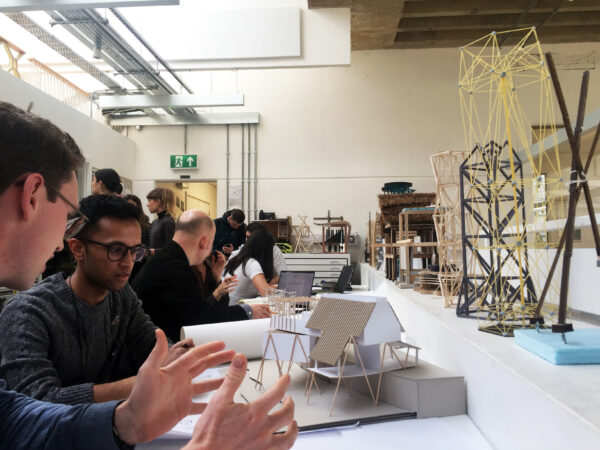
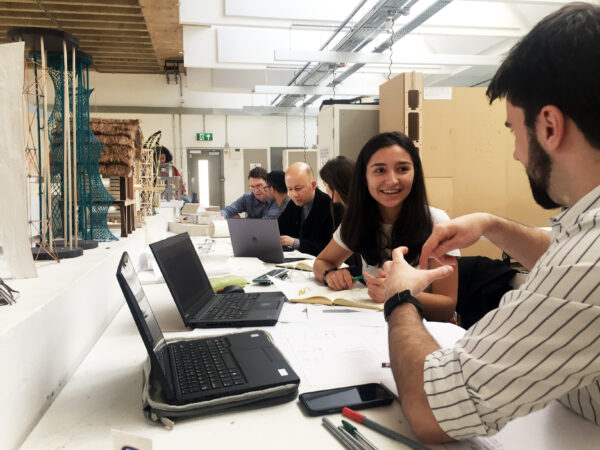
Each year, the final year MArch and Year 3 BA students are invited to attend the Friday Technical Surgeries, to help them develop the technical side of their design projects. 

The tutorials are organised by Dr Will McLean, and the University of Westminster (UoW) Technical staff is joined by the visiting structural engineers, environmental consultants and practising architects who act as consultants for the students. 

In attendance last Friday were:

  • Scott Batty (UoW)
  • Will McLean (UoW)
  • Andrew Whiting (HUT) (UoW)
  • Chris Leung (UCL) (UoW)
  • Paolo Cascone (UoW)
  • Alison McLellan (UoW)

Plus: