Tonight! Lecture by Clancy Moore Architects – Tuesday 28th November, 19:00, Marylebone Hall

Lecture: Clancy Moore Architects

When: Tuesday 28th November 2017, 19:00

Where: Marylebone Hall, Marylebone Campus, NW1 5LS

Access to this event is free of charge. A cash bar will be open after the talk.

Read more about Clancy Moore Architects here.

Featured image: Shatwell stairs model photograph © Clancy Moore Architects

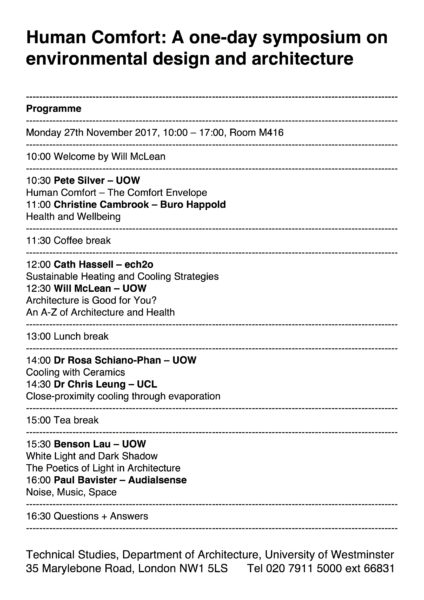
Human Comfort – One-Day Symposium, Today 27th November 10:00-17:00, M416

Human Comfort: A one-day symposium on environmental design and architecture

When: Monday 27th November 2017, 10:00-17:00

Where: Marylebone Campus, M416

Ben Stringer at Hyper Rural: The End of Urbanism, International Symposium at the MMU

On Wednesday 22nd November Ben Stringer (DS12), will participate in the Hyper Rural: The End of Urbanisam, international symposium at the Manchester Metropolitan University, as a part of the Designing the Future Rural; imagining the future rural landscapes, settlements & economies panel, alongside Stefan Petermann (OMA/OSA) and Dr Rosemary Shirley (Art Deptartment, MMU).

The symposium is partly intended as a response to the outcomes of two recent publications and research projects (under). It also aims to document the emergence of a radical new programme of art and agriculture and critical rural arts practices which, in turn, propose a cultural reframing of agriculture and rural development in the post-agricultural era. Including the New Creative Rural Economies initiative (and a conference proposed for 2018) which will further outline a wider strategic role for art, architecture, digital design and the cultural sector in support of rural regeneration and the Government’s (post-Brexit) Industrial Strategy.

Rem Koolhaas’ ‘The Countryside’ – Charles Jencks Award lecture presentation at RIBA in London, 20th December 2012. Above is one of the main slides where Koolhaas contrasts what he describes as the increasing hyper-Cartesian re(de)formation of the countryside, with what he also views as the regressive tendencies of the discourse of urbanism*, and the increasing whimsicality and detachment of some urban public art, architecture and design.

“Our current preoccupation with the city alone is highly irresponsible.. The countryside is now more volatile that the most accelerated city”

” Architects are attracted by contradictions ..we must also look to new ideas and new ways of thinking.. particularly when the old ways of thinking and working beginning to break down.. [at] OMA we look to the countryside and what is happening there is extraordinary..” https://www.youtube.com/watch?v=Y97yXB82nWc

The New Creative Rural Economies report. The symposium is also proposed as a platform and a response to the Littoral Arts Trust’s publication; The New Creative Rural Economies report (2018).

“What the BSE and FMD (Foot and Mouth) disasters have shown us is that agriculture and the rural are now also important cultural responsibilities and arenas and, as such, they also represent urgent new critical spheres for artists, digital media, architects, designers and cultural policy discourse.”

The symposium runs from Tuesday 21st to Wednesday 22nd November.

To book tickets: https://www.landscapeinstitute.org/event/hyper-rural-symposium/

Technical Studies Lecture Series: Prof Sadie Morgan, dRMM, Thursday 23rd November, 6pm, M416

Professor Sadie Morgan – dRMM
Hastings Pier

Reinventing traditional pier design, Hastings Pier provides an open space, able to support a variety of events and uses from circuses to music events, fishing to markets.

Professor Sadie Morgan of dRMM will discuss the community-led regeneration project of Hastings Pier, which is this year’ winner of the RIBA Stirling Prize and the RIBA’s People’s vote. The judge’s citation explains; ‘Hastings Pier is a project that has evolved the idea of what architecture is and what architects should do … dRMM show what incredibly talented and dedicated architects can do: inspire, think big, interact and engage with communities and clients to help them to achieve the seemingly impossible; this is a great message for young architects following in their footsteps.’

Sadie is a founding director of dRMM with Alex de Rijke and Philip Marsh. Over her 20-year career Sadie has had an increasingly significant role in the advocacy of design and architecture through her professional practice and her advisory roles. Sadie is currently chairing the Independent Design Panel for High Speed Two (HS2), reporting directly to the Secretary of State. She is one of ten commissioners for the National Infrastructure Commission (NIC) led by former Cabinet Minister Lord Adonis, and a commissioner for the Thames Estuary 2050 Growth Commission. In 2017, she was appointed as a Mayor’s design advocate for the Greater London Authority and she is Professor of Interiors in the Department of Architecture at Westminster.

For lecture details please contact Will McLean w.f.mclean@westminster.ac.uk

When: Thursday 23rd November, 6pm, Room M416

Where: Department of Architecture, University of Westminster, 35 Marylebone Road, London NW1 5LS

Architecture Research Forum: “In What Style Should We Build” Shahed Saleem, 23rd November, Erskine Room, 5th Floor, 13:00 – 14:00

Shahed Saleem: In What Style Should We Build?

In what style should we build? This question, which has resonated throughout European architectural history for some 150 years, is revisited and reapplied in my talk to the predicament of mosque design in Britain today. Style became an existential battleground for the Victorians, representing contested notions of morality, identity, nostalgia and historicism in a period of self-doubt and reinvention. I argue that Muslim architecture in Britain, and in the West more broadly, where diverse Muslim communities are building as diasporic minority communities, is entwined in similar negotiations of identity and positioning.

Drawing from my research into the architectural and social history of the British mosque, I will provide an historical overview of mosque architecture in Britain, and will set out what I see as its current predicaments. Alongside this, drawing from my own design practice and experiences of working with Muslim communities, I will also suggest my own responses to the questions raised.

Shahed Saleem teaches at the University of Westminster and is a Senior Research Fellow at the Bartlett, Survey of London, and a practising architect.

The Architecture Research Forum is a seminar series hosted by the Architecture + Cities Research Group where staff present work-in-progress for discussion.

ALL WELCOME!

Where: Erskine Room (M/523), Marylebone Campus

When: Thursday 23rd November, 13:00-14:00

Technical Studies Lecture Series: Prof John Chilton, Tonight 9th November, 6pm, M416

The next guest in the Technical Studies Lecture Series will be Prof John Chilton from Nottingham University, who will give a lecture titled “Timber Grid Shells”.

When: Thursday 9th November, 6pm

Where: Room M416, Marylebone Campus, NW1 5LS

All welcome!


DS22 Students Participate in “Here, There, Everywhere” Exhibition _ Opening at P21 Gallery, Tonight 7th November at 6.30pm

Artists, architects, actors, teachers, photographers, film makers and families get together in London and Gaza to inaugurate the exhibition Here, There, Everywhere.

Join us at P21 gallery 6.30 pm today –with a live streaming from Gaza at 7 pm — and get a taste of the work from an adaptation of of Tolstoy’s War and Peace to installations by postgraduate students of architecture from DS22 University of Westminster, to self-build initiatives for reconstruction by Palestine Regeneration Team (PART), the works will reflect on moments of hope to celebrate life.

This is part of a great initiative by Az Theatre to mark 10 years of collaboration with Gaza.

Event Curator: Jonathan Chadwick

When: 7th November 6.30pm

Where: PS21 gallery, 21-27 Chalton Street, London NW1 1JD

Read more here.

DS23’s Crista Popescu Reflects on Angela Brady’s Lecture at the Alumni Lecture Series, WAS

On Tuesday 24th October, Angela Brady, the Co-Founder of Brady Mallalieu Architects, past president of RIBA (2011-2013) currently a Design Council CABE ‘Built Environment Expert’ as well as President of the Architects Benevolent Society,  launched the Alumni Lecture Series organised by Westminster Architecture Society, and gave a talk titled “What it Takes to Design Great Social Spaces.”

Crista Popescu, MArch DS23 student and the president of the Westminster Architecture Society, reflected on Angela Brady’s visit in her recent blog post.

Read an excerpt from her blog below or the full text here.

Her talk focused on how to build “sociable” buildings, as in making sure that today’s high density housing and office buildings offer suitable opportunity for users to meet and socialise. BradyMallalieu designed buildings seem to do just that, with social spaces usually being decided on by consultations with community groups. Their buildings have an elegant appearance, despite using robust materials and detailing.

Some of the things that dwelt in my mind were related to their approach to practice. In Mastmaker Rd project, the practice offered the client an alternative brief that included tenure homes, having an obvious impact on the community that can now afford to buy and live in the new development. At Ivy Hall the architects brought the community together to consider the feasibility of a community centre integrated in the already planned rented social housing development. For the St. Catherine’s Foyer, they put forward the idea to Dublin City Council  although it hasn’t been done yet in Ireland (see foyer.net to read more about the concept). In all these projects, the architects took initiative to improve on the brief as much as they could. It’s a skill to know how to approach the client and the community and understand the specific politics/circumstances of the situation and – most importantly – navigate around it so as to negotiate in your favor.

You can also watch the talk in full here: https://www.youtube.com/watch?v=Xx1crxO1V9c&feature=youtu.be

Harry Charrington and Julia Dwyer to speak at the AA XX 100: AA Women and Architecture in Context 1917-2017_ November 2nd-4th, Architectural Association

AA XX 100: AA WOMEN AND ARCHITECTURE IN CONTEXT 1917-2017

The Head of the Department Prof Harry Charrington and Senior Lecturer Julia Dwyer are to participate in AA XX 100: AA Women in Architecture in Context 1917-2017, an international conference convened by the Architectural Association and the Paul Mellon Centre for Studies in British Art with a rich programme of presentations, panel discussions, distinguished keynotes, and an open jury to celebrate the centenary of women at the AA.

Where: Architectural Association and Paul Mellon Centre, Bedford Sq, London WC1

When: 2nd – 4th November 2017

Tickets (for 3 day event): Full Price £60, Student £30

Book tickets: https://xx.aaschool.ac.uk/conference/ 

View the conference schedule: https://xx.aaschool.ac.uk/wp-content/uploads/2017/10/aaxx_conference_program_3.pdf

As for University of Westminster‘s own history of women in architecture, our first female graduate, Beatrice Pritchard, graduated from, what was then known as, The Regent Street Polytechnic in 1903!

Today our Computer Lab is officially named Beatrice Pritchard Laboratory.

Architecture Research Forum: “Still Dreaming? Space After Spectacle and the Indifference of Architecture” Douglas Spencer – 2nd November, Erskine Room, 5th Floor, 13:00-14:00

Douglas Spencer: Still Dreaming? Space After Spectacle and the Indifference of Architecture 

Susan Buck-Morss, in her Dreamworld and Catastrophe, observed that the end of the Cold War was marked by the passing of the dream-forms of modernity — capitalist, socialist and fascist — as sustained through the experience of the built environment. If, following Walter Benjamin, we understand awakening from the dreamworld to be premised on the conscious realisation of its utopian fantasies, then what hope remained now, she asked, in the absence of any dreamworld? This paper takes up this question through an analysis of the seemingly indifferent and post-spectacular spaces of contemporary architecture, offering, in response, an analysis that explores both its historical and its phenomenological implications.

Douglas Spencer teaches at the University of Westminster and the Architectural Association, and is the author of The Architecture of Neoliberalism (Bloomsbury, 2016).

Where: Erskine Room (M/523), Marylebone Campus

When: Thursday 2nd November, 13:00-14:00