Open Studio is an interactive project run by the School of Architecture + Cities at the University of Westminster to make its design, research and practice-based work available online while it is happening. The site acts as a real time teaching and learning environment in which the work of both students and staff is curated and documented – the work of its design studios, or its other teaching and research groups and workshops. Read more in Blog, follow us on Twitter and like us on Instagram.
AALTO is a documentary film journey into the life and work of one of the greatest modern architects Alvar Aalto. The film shares the love story of Alvar and his architect wives Aino and Elissa Aalto. It takes the viewer on a cinematic tour to their creative processes and iconic buildings all over the world. We visit their buildings in Finland, a library in Russia, a student dormitory at MIT, an art collector’s private house near Paris, a pavilion in Venice – and many other unique places.
The film is available to watch 1-7 June. Register on Eventbrite to receive your free streaming link.
See the film trailer using event link.
Director Virpi Suutari and Professor Harry Charrington will discuss the film on 2 June 18-19.
Professor Harry Charrington, Head of School of Architecture + Cities, is also one of the main narrators and consultants in this newly released documentary film.
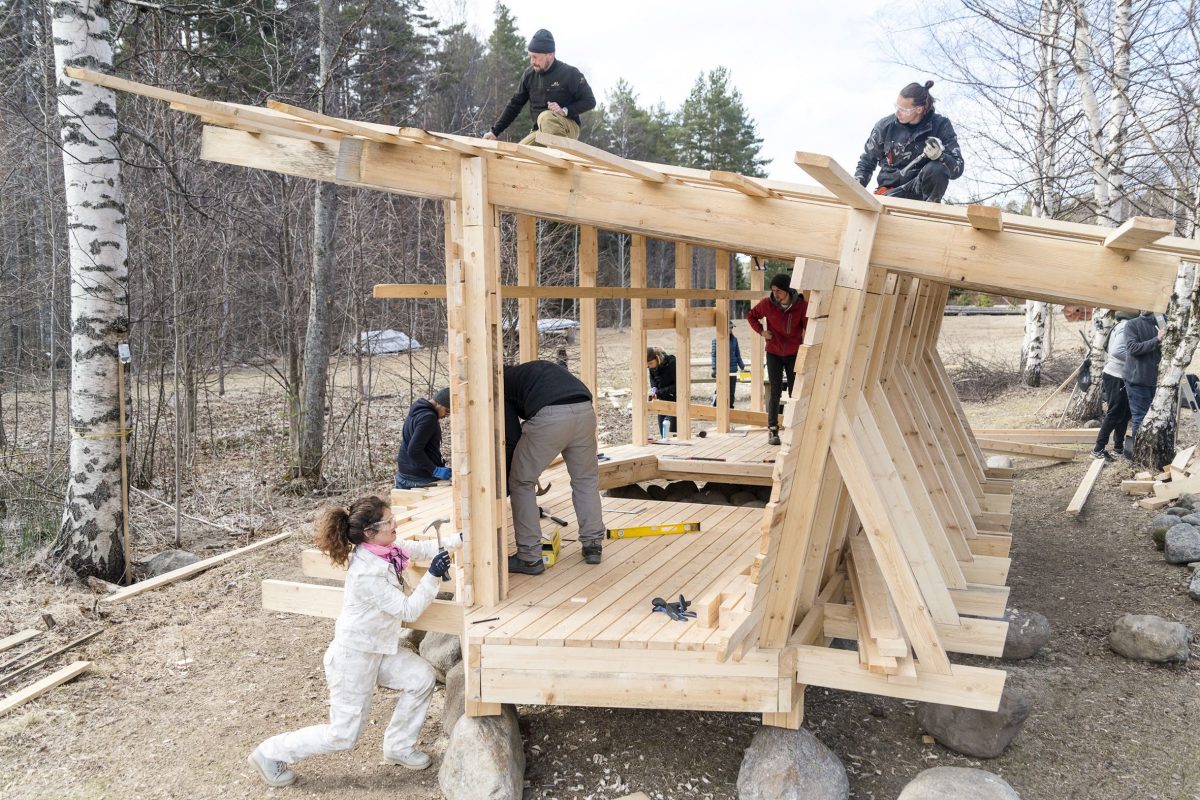
Architecture students are encouraged to apply to design and build workshop in Kangerlussuaq, Greenland that will take place between 29th of July and 9th of August.
The workshop will be located in Kangerlussuaq where the students during a period of 14 days will construct one of the several installations / structures by recycling materials from the local dump site in Kangerlussuaq. The workshop and resulting project will through re-use have a focus on environment and climate challenges on a local and global scale. We will work together with 5 students Arctic DTU in Sisimiut, Greenland.
Tens students will be selected based on 1 page A4 long free form applications. Please send max 1MB email by 25th of May to: sami@ri-eg.com
The workshop will be facilitated by architect professor Sami Rental and architect Harald Seljesæter.
Location and base will be Kangerlussuaq, Greenland.
How to get to Greenland:
Flights from Copenhagen CPH to Kangerlussuaq SFJ
The team will live together in a research station building in Kangerlussuaq. Two people may have to share a room.
The project will cover accommodation and food during workshop. Travels must be covered by participants. No participation fee.
Deadline 25th of June to confirm if the project is possible due to Covid-19. Negative test requested at CPH before boarding the plane, and again at Greenland after 5 days.
Current regulations request quarantine (5 days) which will be the start of the workshop design phase. The team will form a cohort.
The project will reserve tickets with negotiated prices for the flight between Copenhagen-Kangerlussuaq (Air Greenland) for the chosen participants & payment pater.
The team will be 10 international students + 5 students from Greenland. Work together with volunteers and local people.
One free day with social expedition / excursion.
Inussiarnersumik Inuulluaqqusillunga! / Best Wishes!
RAPS Radicality 2021 Conference is pleased to invite extended abstract submissions for 30th April 2021. We invite submissions from architects, academics, artists, environmental scientists, engineers, activists, sociologists and visionaries amongst others to submit 300word abstracts in link below. The Conference will explore radical visions of architecture practice for sustainability through six themes: Architect as Activist; Green Dream; NOT building; Ecological Entanglements; Utopian Realism; Beyond Disruptive Events – Post Pandemic Practices (https://www.rapsresearch.com/services). We are excited to be joined by radical visionaries including Etienne Turpin (ANEXACT),Malene Natascha Ratcliffe (CEO, SUPERFLEX) and Maarten Gielen (ROTOR) in the keynote and debate panel sessions in Sept 2021. The keynote sessions will be reflecting upon human and non-human multi spatial modalities and radical environmental approaches to design as well as modes of cooperative design practice for a radical organisation of the material ‘designed’ and not only ‘built’ environment.
FAME will be hosting their first event to expose the barriers female architects of minority ethnic face in the architecture industry today
About this Event
FAME:Female Architects of Minority Ethnic: founded by Tumpa Husna Yasmin Fellows and Tahin Khan.
FAME Collective is a research-based network founded to support women of diverse backgrounds and ethnicities in architecture and the built environment. Their aim is to raise awareness of the barriers, inequality and lack of diversity in architecture and to demand change that responds to our collective challenges. This event is part of a series of events which will be documented and shared with those in power to change and address the inequality that exists in architecture.
Join us for the launch of FAME’s first symposium ‘EXPOSING THE BARRIERS IN ARCHITECTURE’ hosted by Architecture Foundation via Zoom, and presented by Tumpa Husna Yasmin Fellows. Our distinguished keynote speaker Sumita Singha (recent RIBA Presidential candidate). Our panel of speakers include Annette Fisher (from Let’s BUild), Hilary Satchwell (from Tibbalds and Part W), Femi Oresanya (from HOK and the Chair of the RIBA Architects for Change Expert Advisory Group) and Anna Liu (Director of Tonkin Liu, won the 2018 Stephen Lawrence Prize for Old Shed New House).
This is a participatory event to explore the impact of racism, injustice and inequality contributing to the barriers in architecture. We want to hear about the lived experiences of practitioners, academics and students from BAME backgrounds, to unpack the grievances.
FAME is responding to an urgent need for understanding how race and gender affects established practitioners, young scholars and students, from diverse backgrounds, knowledge and practices by engaging in conversations about the barriers in architecture and the built environment. Our aim is to collectively respond and to demand change and the much-needed support to overcome barriers of racial and gender inequality both in academia and in practices. Our Q + A and participatory sessions will provide an opportunity for participants to share experiences of racial and gender inequality in architecture and the built environment.
This event is being hosted by the Architecture Foundation via Zoom.
The details for all participants will be announced soon.
Tumpa Husna Yasmin Fellows, an architect, researcher, and the BSc Architectural Technology Year 2 leader has published an article in The RIBA Journal on how the architects can use their skills to help improve conditions for the disadvantaged and marginalised communities and members of our society.
The Covid-19 pandemic has disproportionately affected the Black, Asian and Minority Ethnic (BAME) communities and highlighted the urgency for community collaboration towards positive societal changes. The pandemic has changed our lives in many ways. My family is grieving the loss of several family members and friends (of Bangladeshi origin), living in the UK.
Research issued by Public Health England reveals that you are more likely to die from Covid-19 if you are BAME than someone who is white, and people of Bangladeshi ethnicity are twice as likely to die from Covid-19 than those who are white and British. The recent global protests for the Black Lives Matter (BLM) movement brought to focus communities’ collective actions to rise up against racial injustice and various social and health inequalities which have been exacerbated by the pandemic. The power of community action and collective response has become urgent for communities worldwide, whether they are affected by racial injustice, health inequality or new developments in their neighbourhood (sometimes resulting in eviction) and for all those passionate to change systemic racism and inequalities.
As practitioners and architects, we could act many ways to facilitate the voices of those who have been marginalised in the society. One of these is to get involved in local planning issues: for example, by alerting the planning authority to any new development that negatively affects low-income communities in the neighbourhood through gentrification.
I am passionate about being part of the change in my area, so volunteered to be part of my borough’s design review panel. There I have the opportunity to help address some of the issues and push the design team and the developers, to hear and respond to the voices of the community. Unfortunately, in all the recent projects we have reviewed (which happened to be led by influential architects), the design decisions did not reflect local engagement (in an area with one of the largest BAME communities in London), and showed a lack of communication with the community they had designed for. Very little work had been done towards any such local engagement in the design process. […]
Tumpa Husna Yasmin Fellows for RIBAJ, October 2020
Michael Pearce is a graduate of the AA and was a student of the socio-technology gurus Reyner Banham and Cedric Price. Pearce was responsible for the design and supervision of the award-winning Eastgate Centre in Harare and the CH2 (Council House 2) Municipal offices in Melbourne Australia. The metaphor for Eastgate was the termitary, the metaphor for CH2 is the tree. Pearce believes that the architecture and its visual expression should respond to the natural, socio-cultural and economic environment of its location in the same way that an ecosystem in nature is embedded in its site.
Pearce has been working in Zimbabwe and Zambia for 33 years. His experience covers a wide range from building in remote parts of Central Africa to converting buildings in north east England and large-scale city developments in Harare, Zimbabwe. Committed to appropriate and responsive architecture, Michael Pearce has specialised in the development of buildings which have low maintenance, low capital and running costs and renewable energy systems of environmental control. His most recent work involves developing passive control systems in small-scale single storey buildings as well as large-scale commercial multi-storey buildings using building methods which rely even less on imported materials, technologies or human resources. He has been closely involved in the development of rammed earth construction for low cost housing in remote locations in Zimbabwe where transport and energy are the largest costs in producing buildings.
This Saturday, 6th of June at 2pm Hamza Shaikh, DS23 MArch student and the creator of a popular podcast series Two Worlds Design will be joined by three inspiring professionals in the field of architecture to discuss the difficult questions around employment in post-COVID-19 world.
Hamza says:
Many students, myself included, are anxious and confused about the job landscape in architecture. There are many questions to be asked, but we don’t know whom to ask and when to ask. Well, the time to ask is now, and some of the people to ask are joining me this Saturday for this one-off event, LIVE on Instagram. But we need YOU to engage for this to work. Our last event was very successful, and this time we want to hear your voices. If you have any questions, views or experiences on this topic, PLEASE send me a message. We are looking for 3 people to join this event. Otherwise, send your general questions about what you would like to be addressed. See you there!
The event will end with the announcements from Arthur Mamou-Mani and a collective Muslim Women in Architecture, so make sure you tune in!!!
Performance Architecture Online Summer School is an exciting learning journey designed to inspire, broaden and challenge the possibilities of spatial representation and design. Architecture is combined with other disciplines including art, cinematography and performance.
Architecture is a dynamic discipline
The course is applying the toolbox of performance in architectural thinking, towards the production of spatial actions and bodily geometries in space. It is taught by a team of London-based interdisciplinary and international architects and artists including Ursula Dimitriou (StudioSyn), Aliki Kylika (VIPA) and Eliza Soroga (RIPS).
Play with the city; be curious, be caring, be resourceful
This is an incredible opportunity for students / professionals who want to learn new skills, extend their thinking, emerge to an urban cultural landscape, be part of an interdisciplinary and international team, and diversify their project portfolios.
ADAM Architecture is inviting students to apply for the annual Travel Scholarship to support overseas research in architecture, architectural technology and urban design.
The closing date is 30th April 2020. The award of £2,000 supports overseas research in architecture, architectural technology and urban design.
Judges will be looking for a significant piece of original research work, and an outstanding contribution to architectural knowledge. The award is not focused on traditional architecture and the judges are stylistically neutral in their evaluation of the proposals.
The travel scholarship is open to students enrolled at a UK or International University or School of Architecture, studying RIBA Part I; applicants who are 3 years post their Part II qualification; to students studying a CIAT accredited degree, post-graduate course, or equivalent qualification.
First launched in 2005, the scholarship is now in its 15th year and has a proven track record of supporting students to travel overseas to further develop their current research interest or to kick-start something new, often outside of their studies. A brief summary of the previous winners is on ADAM Architecture website. Many past recipients have been invited to present their research at a public event hosted by ADAM Architecture.
Talking about his experience, previous Travel Scholarship winner, Sam Little who studied at the Architectural Association, said:
The Scholarship was fantastic in giving me the impetus to fulfil a project which otherwise would have been left in the locker. It gave me the will and economic means to pursue a trip to Iran to look at 11th century Seljuq buildings. It was a trip which simply would not have been possible without the agency which the scholarship gave me. The whole process was thoroughly enriching and being encouraged to work with freedom helped to place an emphasis on the experience of the trip, rather than any rigid preconceived understanding of the subject. I would encourage anyone thinking about applying to do so.
Where: M416, Robin Evans Room, 35 Marylebone Road, London NW1 5LS
Eladio Dieste (1917-2000) was a Uruguyan engineer who studied in the Faculty of Engineering at the University of Montevideo. In his book on the work of Dieste, The Engineer’s Contribution to Contemporary Architecture: Eladio Dieste, Remo Pedreschi explains that Dieste’s university education was formative and crucially provided him with the fundamentals of maths and physics, which was so instrumental in his conception of structures. Some of the earliest work that Dieste undertook as an engineer was on concrete shell structures and on first glance whilst studying projects such as his free-standing vaults for ANCAP in Montevideo (1955) you could easily be forgiven for thinking that they were fabricated out of reinforced concrete. In fact, these shells were made from a unique system devised by Dieste of clay bricks reinforced with steel cables and cement. As with other great structural ‘artists’ of that period such as Felix Candela and Pier Luigi Nervi, Dieste was engineer, builder (and latterly architect) of his projects. He established the firm Dieste y Montañez in 1955 and as Remo Pedreschi explains “…the firm was in effect, a major design and build contractor that had developed its own innovative construction techniques.”
Remo Pedreschi is a chartered engineer and Professor of Architectural Technology at the University of Edinburgh. He joined that university after holding senior positions in the construction industry and continues to work with industry. He has undertaken research in a range of materials including concrete, steel, timber, and stone and currently is Director of the Master’s programme in Material Practice. He obtained his PhD for research in post-tensioned brickwork and has published a number of scientific papers in his area. This research led to his interest in the work of Eladio Dieste. He developed and co-edited a series of books exploring the relationship between engineering and architecture, The Engineer’s Contribution to Architecture, for which he wrote the monograph on Eladio Dieste. Remo was also the co-author of the seminal Fabric Formwork book.