Recording of the “How will we live together? Westminster at the Venice Biennale” event is now available online

Recording of the online event that celebrates University of Westminster‘s work exhibited at the prestigious 2021 Venice Architecture Biennale (22nd May-21st Nov), which took place on the 9th of June 2021, is now available for viewing here.

Academics based within the College of Design, Creative and Digital Industries have co-produced three different installations to respond to the theme: How will we live together?

At the event, we hear more about the ideas underpinning each piece of work, and – given the fundamental themes they address – discuss how architecture and practice based research can help us to better understand the world’s most pressing challenges.

Following an introduction to the three installations, Ifor Duncan, an academic based at Ca’ Foscari University of Venice, responds to the work. These contributions are followed by a panel discussion and questions from the audience.

More details about the installations and the academics involved are provided below.

Monsoon Assemblages (led by Lindsay Bremner) and Office of Experiments (led by Neal White) have created an immersive installation that challenges and redefines ideas of border, scale and agency. It draws on climate data and field work to convey how climate change and the Anthropocene are resulting in increasing monsoon volatility, shorter rainy seasons and more frequent extreme weather events. The installation investigates these events through the flight of the Globe Skimmer dragonfly that follows the monsoon from east Africa to southeast Asia and back again. Video footage of the dragonfly collected during field work is projected into the exhibition space highlighting the vulnerability of the dragonfly to shifting monsoonal dynamics.

In a collaboration with the V&A Museum, Shahed Saleem’s Pavilion looks at the self-built and often undocumented world of adapted mosques to explore contemporary multiculturalism in London. The work explores three different case studies that illuminate stories of immigration, identity, and community aspiration. The cases are the Brick Lane mosque, a former Protestant chapel then Synagogue; Old Kent Road mosque housed in a former pub; and Harrow Central mosque, a purpose-built space that sits next door to the converted terraced house it used to occupy. The Pavilion is partly carpeted, as in a mosque, and these stories are explored through 3D architectural reconstructions, filmed interviews and photographs.

The African Fabbers School video-installation project, curated by Paolo Cascone and Maddalena Laddaga, proposes an innovative research by practice agenda for the next generation of European and African architects. The African Fabbers School [AFS] is an itinerant laboratory of ecological design and self-construction for community-oriented projects between Europe and Africa. This ecosystem of site-specific projects has structured an abacus of paradigmatic design to build modus operandi based on a learning by doing methodology. Thanks to the interaction between people from different backgrounds (including African artisans, local communities, European students) the [AFS] investigates the relationships between traditional knowledges, advanced design processes and digital manufacturing.

Respondent

Ifor Duncan is a Post-doctoral fellow in Environmental Humanities at the Center for the Humanities and Social Change, Ca’ Foscari University of Venice. He is a writer and inter-disciplinary researcher, with a PhD from the Centre for Research Architecture, Goldsmiths. His research concerns the relationships between political violence and watery spaces and materialities. Previously Ifor taught at the CRA and in the School of Architecture at the Royal College of Art.

SA+C & LFA: Thinking, Practising, Listening; Exploring Inclusion in Architecture | Monday, June 21, 2021 from 9:30 to 13:00 (BST)

This online symposium will focus on the importance to architectural practice and research of listening. To listen effectively is not just to hear: it means actively seeking perspectives from those people in society whose voices are often the least audible. In exploring a wide range of voices in architectural practice, theory and history, the symposium intersects with the themes of decolonisation and inclusion, which are embedded in the teaching and research culture of the University of Westminster.

The symposium will also focus on the role of universities in developing and promoting the practice of listening and will feature workshops and lightning presentations from students that explore reciprocal dialogue between teachers and learners within architectural education.

The keynote lecture will be delivered by Dr Huda Tayob, Senior Lecturer at the University of Cape Town. Her research focuses on migrant, minor and subaltern architectures, the politics of invisibility in space, and the potential of literature to respond to archival silences. She is co-curator of the open access curriculum Racespacearchitecture.org and the digital podcast series and exhibition Archive of Forgetfulness (archiveofforgetfulness.com).

Huda will be speaking on Transnational Architectures of Care, through her research on Somali malls in South Africa and the US.

09:30 Introduction and opening

Kate Jordan & Shahed Saleem

9.45 Session 1

Jane Tankard & Design Studio 3.1

A collaborative visual and verbal presentation emerging out of conversations with students over 7 years. The meetings were structured around speaking and listening to thoughts on pedagogy, studio, reciprocity and notions of home.

Christine Wall

How are architectural histories silenced? This question is explored with reference to two ongoing studies, one a 1970s architectural collaborative in London, and the other the Little Aden Cantonment, the 1960s extension of British colonial military accommodation which became the largest fully modular project in the world.

Tumpa Husna Fellows

Through her practice based research, Tumpa asks how can architecture amplify the voices of underrepresented communities to enable spatial justice and create social value in places, buildings and neighbourhoods? How can designing inclusive spaces help us respond to the climate injustice?

5 min break

11.15 Session 2

Maria Kramer

Leyton Community Hub; a description of the ongoing process of negotiating the complex mix of stakeholders in this project, from student engagement, public consultations & council requirements. How are these various needs and aspirations understood and managed through processes of listening and engaging?

Davide Deriu

‘Beautiful idea; beautiful building; beautiful materials…but I have problems with vertigo.’

Do practising architects listen to prospective users? How can different perceptions and experiences of space be accounted for? Drawing on his ongoing research on architecture and vertigo, this presentation shall discuss how embodied subjectivities are often neglected in the design process.

Through selected examples, this presentation will situate the issue of vertigo in relation to a broad understanding of spatial experience, and argue that a more inclusive approach might be developed through listening and care.

Elantha Evans & Design Studio 11

An introduction to an experimental research session to re-frame design studios with the empathic imagination in mind.

5 min break

12.15 Session 3

Introduction by Samir Pandya, Assistant Head, School of Architecture + Cities

Keynote

Huda Tayob, University of Cape Town

Transnational Architectures of Care

Conversation

Click here to register for the event via Eventbrite

Practices of Care: Collaboration between University of Westminster and Imperial College | Friday, June 11, 2021 at 17:00 (BST)

Please join us on 11 JUNE 21 @ 5 pm (UK time) for an online panel discussion on Practices of Care, reflecting on a Co-Production Workshop held between the University of Westminster and Imperial College London.

How does one educate a professional – an architect, a doctor? Competencies are one thing, but what about qualities such as ethics, or duty of care? Is a key skill of being an architect or a clinician the ability to listen to a variety of stakeholders and work collaboratively?

Practices of Care bring together a panel of architects and doctors, to discuss what it might mean to be a caring professional and what the two disciplines can learn from each other.

The event is part of the London Festival of Architecture.

Please register using the Eventbrite link below. Details on how to attend will be provided on Eventbrite.

https://www.eventbrite.co.uk/e/practices-of-care-tickets-154377857327

More details on the Workshop and an Online Exhibition of student posters are available on OPEN Studio

http://www.openstudiowestminster.org/co-production-2020-2021/

Invitation to OPEN2021 [online] | Thursday, June 17, 2021 from 18:30 to 21:00 (BST)

THE UNIVERSITY OF WESTMINSTER’S SCHOOL OF ARCHITECTURE + CITIES INVITES YOU TO OPEN 2021


Thursday 17th June           To be opened by Sunand Prasad

Head of School Harry Charrington cordially invites you to attend the opening of our graduating students’ virtual degree show, OPEN 2021, featuring work from Architecture BA, Interior Architecture BA, Architecture and Environmental Design BSc, Architectural Technology BSc, Designing Cities BA and Master of Architecture (MArch) (RIBA pt II).

The degree show is part of the School of Architecture and Cities and the second online edition of its annual Exhibition of work.

PLEASE SEE THE INVITATION FOR DETAILS AND TO REGISTER FOR THE LAUNCH (VIA EVENTBRITE).

OPEN 2021 CONTINUES ONLINE 18 JUNE – 30 SEPTEMBER at OPENWestminster.London

London Festival of Architecture Events

In addition to OPEN 2021, the University of Westminster has a number of events taking place as part of this year’s London Festival of Architecture:

10 June, 5.30 – 8pm

Open Gaza: Architectures of Hope

https://www.eventbrite.co.uk/e/open-gaza-architectures-of-hope-in-memory-of-michael-sorkin-tickets-154395817045

11 June, 5 – 7pm

Practices of Care – A Cross-Disciplinary Discussion on Designing for Mental Health and Wellbeing

https://www.eventbrite.co.uk/e/practices-of-care-tickets-154377857327

21 June, 10am – 1pm

Thinking Practicing Listening

https://www.eventbrite.co.uk/e/thinking-practicing-listening-tickets-154373271611

25 June, 4 – 6pm

Let’s Build @StJohn’s School Camberwell

https://climatedemonstrator.org.uk/

27 June, 2 – 4pm

Co-Production Community Hub Workshop

https://www.londonfestivalofarchitecture.org/event/co-production-community-hub-workshop/

Disassembling the Woven Pavilion at the Marylebone Campus | Tuesday, June 8, 2021, 10:30-14:00 (BST) | Apply now!

Are you interested in construction and making?

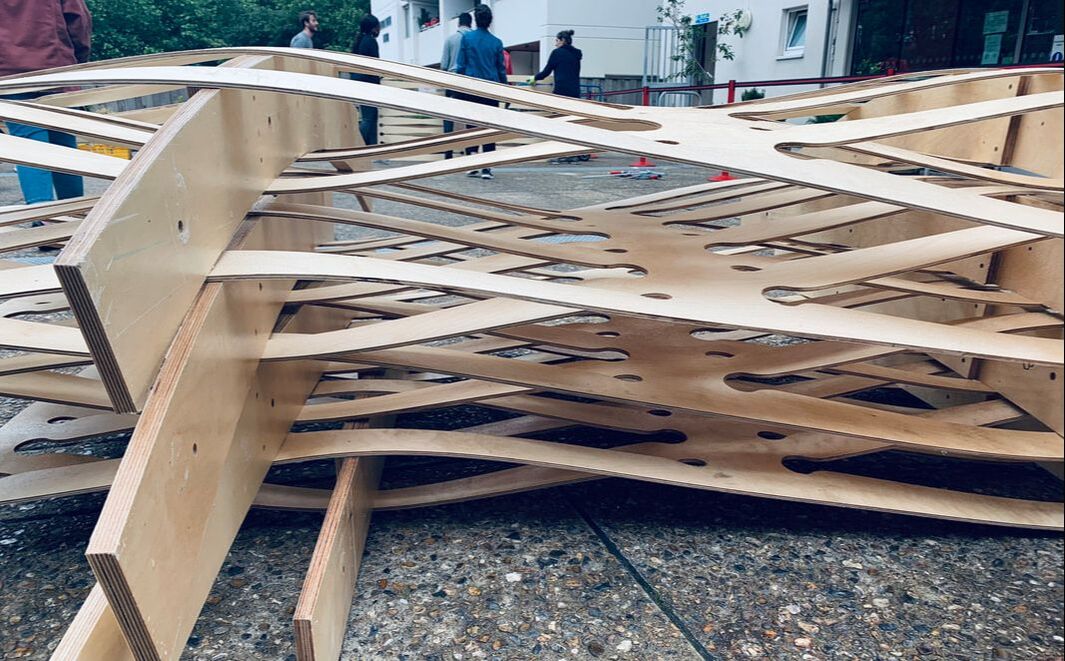
Please come on Tuesday, 8th of June between 10.30am and 2pm, and have some fun taking apart the Woven Pavilion at the rear podium at the Marylebone Campus and learn about the construction process. After revarnishing and making good off-site some of the QHT funded arches it will be reassembled at Harrow Campus.

Please email Maria Kramer M.Kramer@westminster.ac.uk for further information.

https://www.instagram.com/uow_live_studio3.2/

http://www.room102.com/woven-pavilion.html

Climate Demonstrator: Live build summer school at Westminster | Open to all University of Westminster students | June 14 – 25, 2021

We are pleased to announce the launch of Climate Demonstrator: a live build summer for Westminster students in collaboration with St John the Divine School Kennington.

Be part of a two-week live build summer from 14th to 25th June. Work as part of team to design and fabricate an exciting, interactive playground installation that demonstrates the science of buildings and their interaction with climate and biodiversity. The summer school is open to all Westminster students.

Sign in to your University of Westminster google account and click here to go to the registration form. Click here for the summer school website.

What’s the challenge?

To design and fabricate an exciting interactive playground installation that demonstrates the science of buildings and their interaction with climate and biodiversity.

Who can take part?

The project is open to all students at University of Westminster.

How will I be involved and what will I be doing?

You will be assigned to a team to work with students of other courses and levels. The first stage will be an intensive one-day design charrette or workshop to develop a final design and make a concept model. The models will be taken to the school for discussion and debate. The next stage will be to produce fabrication drawings leading to construction of the final work. The installations will be taken to the school for a day of interaction and exhibition with schoolchildren and for display as part of the London Festival of Architecture.

When will it take place?

The summer school will be held for two weeks from 14th to 25th June, culminating in an exhibition on the last day in the ground of St. John’s School. Everything will be happening on campus and on site so you’ll need to be in London and available to contribute during two weeks.

What will I get out of it?

Constructive fun! After over a year of isolated working this is chance to celebrate a return to face-to-face life and interactive hands-on making. Work with students from other disciplines and levels. Develop organisational and project management skills. Make contact with architects, stakeholders and the schools community. The event is part of the London Festival of Architecture so your work will be on public exhibition.

I’m interested. What do I need to do next?

To register, click here to complete the form

Featured image: Domestic Appliances for Science Oxford, Oxford (UK) 2012

How will we live together? – Westminster at the Venice Biennale | Wednesday, June 9, 2021, 16:00-18:00 (BST)

When: Wednesday, 9th of June 2021, 16:00-18:00 (BST)

Register: https://www.eventbrite.co.uk/e/how-will-we-live-together-westminster-at-the-venice-biennale-tickets-155634983425

Join us for an online event that celebrates University of Westminster‘s work that is being exhibited at the prestigious 2021 Venice Architecture Biennale (22nd May-21st Nov).

Academics based within the College of Design, Creative and Digital Industries have co-produced three different installations to respond to the theme: How will we live together?

At the event, we will hear more about the ideas underpinning each piece of work, and – given the fundamental themes they address – discuss how architecture and practice based research can help us to better understand the world’s most pressing challenges.

Following an introduction to the three installations, Ifor Duncan, an academic based at Ca’ Foscari University of Venice, will respond to the work. These contributions will be followed by a panel discussion and questions from the audience.

More details about the installations and the academics involved are provided below.

Monsoon Assemblages (led by Lindsay Bremner) and Office of Experiments (led by Neal White) have created an immersive installation that challenges and redefines ideas of border, scale and agency. It draws on climate data and field work to convey how climate change and the Anthropocene are resulting in increasing monsoon volatility, shorter rainy seasons and more frequent extreme weather events. The installation investigates these events through the flight of the Globe Skimmer dragonfly that follows the monsoon from east Africa to southeast Asia and back again. Video footage of the dragonfly collected during field work is projected into the exhibition space highlighting the vulnerability of the dragonfly to shifting monsoonal dynamics.

In a collaboration with the V&A Museum, Shahed Saleem’s Pavilion looks at the self-built and often undocumented world of adapted mosques to explore contemporary multiculturalism in London. The work explores three different case studies that illuminate stories of immigration, identity, and community aspiration. The cases are the Brick Lane mosque, a former Protestant chapel then Synagogue; Old Kent Road mosque housed in a former pub; and Harrow Central mosque, a purpose-built space that sits next door to the converted terraced house it used to occupy. The Pavilion is partly carpeted, as in a mosque, and these stories are explored through 3D architectural reconstructions, filmed interviews and photographs.

The African Fabbers School video-installation project, curated by Paolo Cascone and Maddalena Laddaga, proposes an innovative research by practice agenda for the next generation of European and African architects. The African Fabbers School [AFS] is an itinerant laboratory of ecological design and self-construction for community-oriented projects between Europe and Africa. This ecosystem of site-specific projects has structured an abacus of paradigmatic design to build modus operandi based on a learning by doing methodology. Thanks to the interaction between people from different backgrounds (including African artisans, local communities, European students) the [AFS] investigates the relationships between traditional knowledges, advanced design processes and digital manufacturing.

Respondent

Ifor Duncan is a Post-doctoral fellow in Environmental Humanities at the Center for the Humanities and Social Change, Ca’ Foscari University of Venice. He is a writer and inter-disciplinary researcher, with a PhD from the Centre for Research Architecture, Goldsmiths. His research concerns the relationships between political violence and watery spaces and materialities. Previously Ifor taught at the CRA and in the School of Architecture at the Royal College of Art.

Book Launch + Webinar: “Open Gaza: Architectures of Hope” | Thursday, June 10 , 2021 at 18:00 (BST)

Please join MArch DS22 tutors and the founders of Palestine Regeneration Team, Senior Lecturers at the UoW, Yara Sharif and Nasser Golzari, on the 10th of June 2021 at 6pm (BST) for a webinar and a book launch for Open Gaza: Architectures of hope, co-edited by the late Michael Sorkin and Deen Sharp.

In an attempt to cultivate hope, a group of scholars got together to explore imaginative spatial scenarios to heal the fractured city of Gaza. While we share some of the work, we will also be discussing the wider subjects of Architecture of Care and the Right to the City.

The event hosted by the Head of School of Architecture + Cities, Professor Harry Charrington, is a tribute to Michael Sorkin and a testament to his insistent cry for a right to the city and a spatial justice for all.

The event is part of London Festival of Architecture.

For further details and to register for the event please go to Eventbrite.

Royal Gold Medal Ceremony 2021 | Sir David Adjaye | Wednesday, May 26, 17:00-18:30 (BST)

Join the online presentation of the 2021 Royal Gold Medal to Sir David Adjaye OBE, live from Accra, Ghana and London, UK.

Given in recognition of a lifetime’s work, the Royal Gold Medal is approved personally by Her Majesty the Queen and is given to a person or group of people who have had a significant influence ‘either directly or indirectly on the advancement of architecture’.

Sir David Adjaye has achieved international attention for an exceptional body of work over 25 years. Drawing on his cited influences including “contemporary art, music and science to African art forms and the civic life of cities”, his completed projects range from private houses, exhibitions and furniture design, through to major cultural buildings and city masterplans. From the start of his career he has combined practice with teaching in schools of architecture in the UK and the USA, including professorships at the universities of Harvard, Michigan, Pennsylvania and Princeton.

As a student, he won the 1990 RIBA Bronze Medal. He was knighted in the 2017 New Year Honours for services to architecture, following an OBE in 2007.

His practice, Adjaye Associates, was founded in 2000 and today has studios in Accra, London and New York, with projects across the world.

The event will begin with the presentation of the Royal Gold Medal to Sir David Adjaye, followed by an In-Conversation with Lucy Tilley, Associate Principal, Adjaye Associates. The event will end with an audience Q&A, allowing viewers to submit their questions to Sir David Adjaye.

50% discount for students.

For more details on the event and booking please go to Eventbrite.

London Festival of Architecture 2021 Film Screening: Aalto (Virpi Suutari 2020) + Prof Harry Charrington and Virpi Suutari in conversation | June 2, 2021 18:00-19:00

AALTO is a documentary film journey into the life and work of one of the greatest modern architects Alvar Aalto. The film shares the love story of Alvar and his architect wives Aino and Elissa Aalto. It takes the viewer on a cinematic tour to their creative processes and iconic buildings all over the world. We visit their buildings in Finland, a library in Russia, a student dormitory at MIT, an art collector’s private house near Paris, a pavilion in Venice – and many other unique places.

The film is available to watch 1-7 June. Register on Eventbrite to receive your free streaming link.

See the film trailer using event link.

Director Virpi Suutari and Professor Harry Charrington will discuss the film on 2 June 18-19.

Professor Harry Charrington, Head of School of Architecture + Cities, is also one of the main narrators and consultants in this newly released documentary film.

Tickets/Booking:
https://www.eventbrite.co.uk/e/aalto-virpi-suutari-2020-film-screening-tickets-150740666391